Colouring Cities Research Programme · Ghana
Colouring Ghana is a free, collaborative research platform that collects, visualises, and shares open spatial data on Ghana's buildings, helping communities, government, and researchers make better decisions about our built environment.
Colouring Ghana is a research-led, free public resource providing open spatial data on Ghana's buildings and natural environment, built collectively by and for academia, communities, government, industry, and the third sector.
The platform enables individuals, communities, researchers, planners, and government agencies to collaboratively capture and share information about Ghana's buildings, from basic location and land use data to structural characteristics, age, energy use, and disaster vulnerability.
All data contributed to Colouring Ghana is released as open data under the Open Database Licence (ODbL), making it freely available for research, planning, policy-making, and education. No special skills are required to contribute. Anyone with local building knowledge can help fill in the map.
The project aims to build a rich, granular, and continuously updated national database of building attribute data to support evidence-based urban planning, climate adaptation, infrastructure investment, and disaster risk reduction across Ghana.
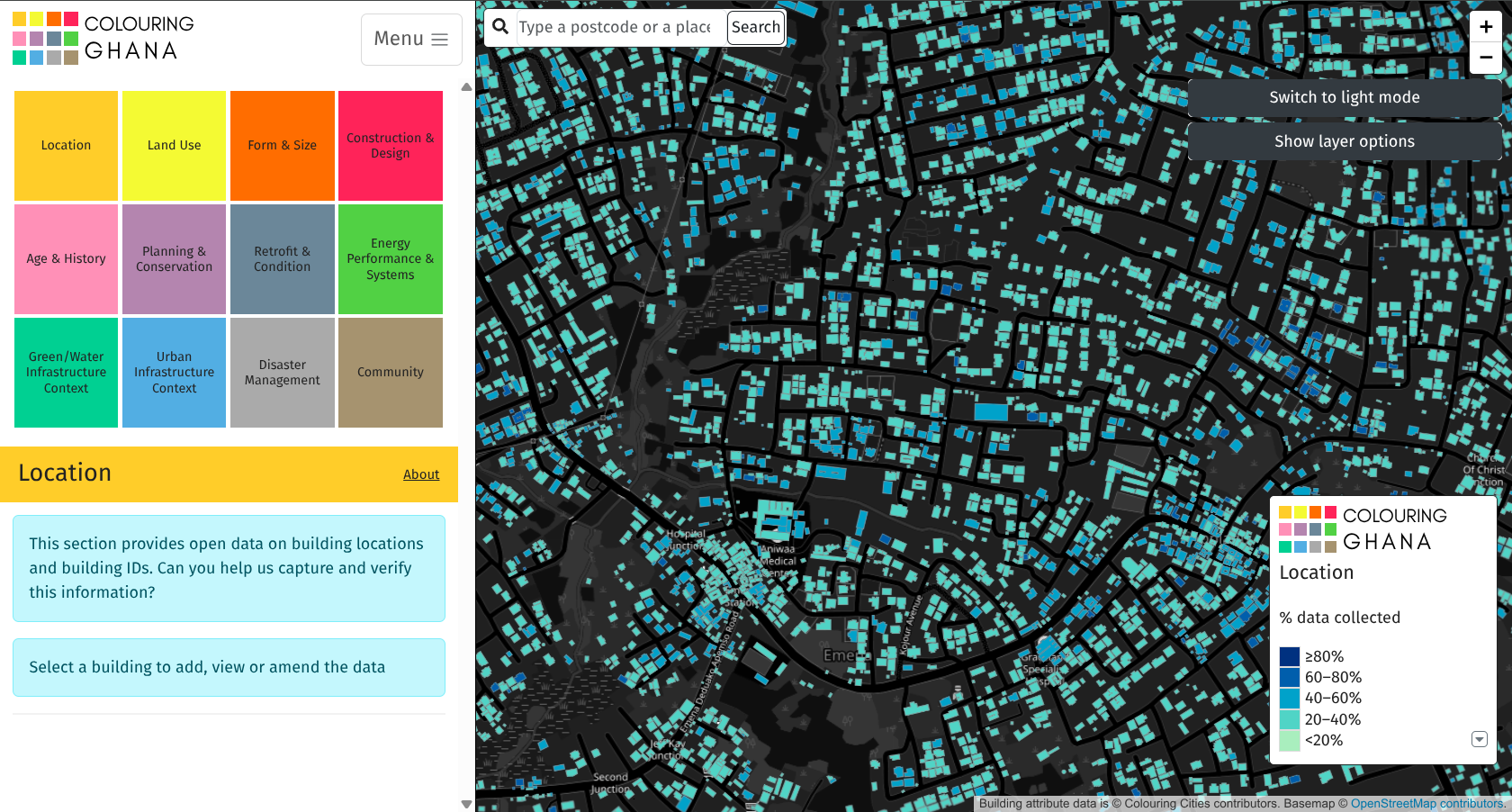
Explore the Platform →The platform captures 12 categories of building attribute data, colour-coded by theme and collaboratively filled in by contributors across Ghana.
The colour scheme mirrors the Colouring Cities Research Programme's shared framework. Each category can be explored independently on the platform.
There are many ways to help — whether you're on the ground, at a desk, or at a university. Every data point counts.
Create a free account on the Colouring Ghana platform. Registration only requires a username and password — no personal information is required.
Use the interactive map to navigate to any building in Ghana. You can search by place name or postcode, or simply zoom into your neighbourhood.
Click a building to see what data has already been captured. Fill in missing fields or verify information you know to be correct.
Go for a walk in your neighbourhood and note building characteristics — construction type, number of storeys, approximate age — then add them to the map.
Have archival records, local history knowledge, or professional expertise in urban planning, architecture, or engineering? Your specialised knowledge is invaluable.
Bring together students, community groups, or colleagues for a collaborative mapping session. We can provide training materials and support for group events.
New to the platform? Follow this step-by-step guide to get started with mapping and contributing building data.
Use the search bar or scroll/zoom to navigate. Buildings are colour-coded by data completeness. Click any building to begin.
Click the Menu button at the top of the platform, then select Sign Up from the dropdown. Choose a username and password — providing an email address is optional. Your contributions will be attributed to your chosen username.
Select a category from the left panel. Click "Edit" to enter data. Use the category guide for help with each field. Save when done.
Browse buildings in your area. If existing data looks correct, confirm it. If incorrect, use the edit function to suggest a correction.
Switch between data layers using the left panel. Use "Show layer options" to customise the map view. All data is downloadable as CSV.
The platform works on smartphones — ideal for field surveys. Open the map in your mobile browser, log in, and add data on the go.
The Colouring Ghana platform is free and open to everyone. No prior experience in GIS or data entry is needed — just local knowledge and curiosity.
Viewing data does not require registration. An account is only needed to add or edit building data.
Ghana's rapid urbanisation demands better building data. Without it, planning decisions are made in the dark. Colouring Ghana changes that.
Understanding the age, materials, and energy performance of Ghana's building stock helps identify where retrofit interventions are most needed as climate pressures intensify.
Detailed data on building construction type, condition, and location enables better assessment of vulnerability to floods, earthquakes, and other hazards common in Ghana.
Planners, municipal authorities, and government agencies gain access to granular, up-to-date data to support infrastructure investment decisions and spatial development plans.
The open dataset supports research in urban studies, architecture, civil engineering, geography, environmental science, and development studies across Ghanaian universities.
Colouring Ghana contributes to Ghana's national spatial data infrastructure, filling critical gaps in building attribute data not captured by existing national datasets.
Citizens gain agency over the data that describes their neighbourhoods. Communities can use the platform's open data to advocate for better services and infrastructure.
The project is a collaboration between KNUST and the global Colouring Cities Research Programme network.
Host Institution
Research Programme
Local Collaborator — Pilot Study Area
The Oforikrom Municipal Assembly (Kumasi, Ghana) is Colouring Ghana's inaugural government collaborator and the host of our pilot study. All building data currently on the platform covers the Oforikrom Municipal area. We are grateful for their support and look forward to expanding this partnership. We warmly welcome other Metropolitan, Municipal, and District Assemblies (MMDAs) across Ghana to join the programme and help build a comprehensive national building database.
International Collaborators — CCRP Network
We welcome enquiries from researchers, planners, students, community organisations, journalists, and anyone interested in contributing to or collaborating with Colouring Ghana.